Showing posts with label repentance. Show all posts

Saturday, March 21, 2026

CHRIST’S LAST WORD TO HIS CHURCH


In Revelation 2-3, we have seven messages to seven churches. These churches were real people in real places with real potentials and real problems. Yet, in these we have vital lessons for all churches of all locations and for all time.

Each one begins similarly, “To the angel of the church…” and ends with, “He who has an ear, let Him hear what the Spirit says to the churches.”  The Greek word translated, “angel,” literally means, “messenger,” and most often refers in the Bible to a heavenly messenger—a celestial being. While that is possible here, nowhere else in Scripture do we read of a specific angel assigned to a local church. Instead, I think it more likely as descriptive of a human messenger—the shepherd of that local flock. The first eyes to look on the letter would be the one responsible to proclaim it to the congregation. 

What a great opportunity!  The pastor has the privilege of hearing from God that He might speak for God. Yet, this is also a grave responsibility! We are not only in a privileged, but a pivotal position as God’s representatives. Pastor, you are an angel—don’t act like a devil!  One day we will stand before the Lord and be judged accordingly.

In each letter, the Lord identifies Himself in a specific way according to the particular needs of that local congregation. “I know your works,” is the declaration of Christ to each church. What ultimately matters is not what the congregation thinks of itself, nor what the community thinks of the church, but what Christ knows about that local assembly. He knows it all—nothing is hidden to His eyes, “like a flame of fire,” (2:18). The Lord commends the church for the good He discerns (and there is some good in all but one—Laodecia, the lukewarm church that nauseated Him).  The Lord confronts the church for the problems He detects (and there is some in all but two—Smyrna, the persecuted church that was faithful to Him—purified by fiery trials and Philadelphia, the missionary church—the church of the open door). There is the promise of a particular reward for each church that would hear and heed the message.

Those local churches were comprised of individual members. Should even one respond in faith and obedience, there is the promise of reward. Surely, the pastor is the first one who needs to submit to the authority of Christ in His church. If He will submit and then share the Word, as members one by one do likewise, then there is hope for the Lord’s blessing on that fellowship. 

“He who has an ear, let Him hear what the Spirit says to the churches.”  We are called to “overcome,” the world, the flesh, and the devil. God gives us His Scripture to guide us and His Spirit to empower us through faith and obedience.

Preacher, it starts with you. God has placed you and your congregation strategically to make a difference for Him in this time and place. Will you?

Tuesday, July 12, 2022

THE BLESSEDNESS OF FORGIVENESS

Both the commencement and conclusion of Psalm 32 provide the bookends for the content: the blessedness of forgiveness. David starts with an expression of happiness in the Lord, and sums up with an exultation of hallelujah to the Lord.

Consider THE COVERING OF SIN (v.1-5). Sin calls for a covering. The choice is in who will do the covering and the resulting consequences. There is blessing when God covers our sin, but a burden when we seek to do so. It is  the difference between heaven and hell for sinners and happiness or heaviness for saints. There is gladness when God covers sin and groaning when we attempt it. It is fascinating that the great salvation word, “atone,” literally means, “to cover.”

Blessedness comes with THE CONFESSION OF SIN (v.5-7).  God removes the sin we refuse to cover, but will reveal that which we seek to hide. He is writing it down (cf. Rev.20:12). The godly are not sinless, but swift and sincere in repentance. The wicked make excuses and shift blame, hesitant to admit guilt. At best, they are superficial in remorse. The waters of judgment will not reach the repentant.  God will be their, “hiding place.”  The wicked will be swept away. The story of Noah illustrates this. It is interesting that the word, “pitch,” that Noah used to waterproof the ark, is the Hebrew, “kaphar,” also rendered, “atonement!”

We conclude with THE COUNSEL OF SANCTIFICATION (v.8-11). God’s grace in forgiveness is never meant to be an excuse for sinfulness. Repentance means we are counseled by God from the path of sin to the pursuit of sanctification. It is the highway of holiness that yields happiness. Stubborn mules can be broken—and God will chasten us when needed. Yet, far better to be compliant than face correction!  There is the choice of a sorrowful life in sin or the steadfast love from sanctification.

Friday, December 27, 2019

BAD NEWS; GOOD NEWS


“Jesus said to him, ‘I am the way, the truth, and the life. No one comes to the Father except through Me.’”
— ‭‭John‬ ‭14:6‬‬

Our spiritual condition is a bad news, good news scenario. The bad news is that we are sinners separated from God—a universal condition that we are born in and throughout a lifetime of rebellious choices become entrenched in. Our final destination on that path is hell. Where is the good news?  It is this—God did not leave us in that state without remedy. We can be born again!  That second birth enables us to be in a right relationship with God and repentance brings us to right choices on a path that ends in heaven.

Without Christ, you are lost.  We are wandering farther and farther from God and closer and closer to the Abyss. That’s the bad news.  The good news is Christ is the Way.  Jesus came to be the bridge across the great divide between us and Holy God.

Without Christ, you are deceived.  That’s the bad news.  Our minds are twisted by error. The good news is Christ is the Truth.  His life that He demonstrated and the lessons that He declared revealed the truth about God and His ways.

Without Christ, you are dead in sin.  You are not merely sick, but dead, and dead people cannot fix themselves. That’s the bad news.  The good news is Christ is the Life.  He possesses resurrection power and by His Spirit will summon you through the Word of God to life.

If you have come to Christ, then rejoice and give Him praise. It was not because of anything good you have done, but the good in Him. That’s grace!

If you have not come to Him, will you hear His voice, and respond to His call today?

Friday, November 15, 2019

IS THERE STUBBORN REJECTION OR SCRIPTURAL RECEPTION?


“‘But they refused to heed, shrugged their shoulders, and stopped their ears so that they could not hear. Yes, they made their hearts like flint, refusing to hear the law and the words which the LORD of hosts had sent by His Spirit through the former prophets. Thus great wrath came from the LORD of hosts. Therefore it happened, that just as He proclaimed and they would not hear, so they called out and I would not listen,’ says the LORD of hosts. ‘But I scattered them with a whirlwind among all the nations which they had not known. Thus the land became desolate after them, so that no one passed through or returned; for they made the pleasant land desolate.’” (Zechariah‬ ‭7:11-14‬‬)

If you were to ask me about how many responded to the sermon last Sunday, I would tell you, “100% !  Everyone responded. Some said, ‘Yes,’ and some said, ‘No,’ but all responded.” Each time you walk out of the meeting house doors, you leave better or worse—closer to God or farther away.

Notice in these verses how the rejection of the Word became more pronounced. Truth makes a heart healthy or hard.

Arteriosclerosis is a physical malady where the arteries that carry the life-giving flow of blood become hard and clogged by cholesterol.  The result can be stroke, heart-attack, even death.  It is all the more deadly because the development of the disease is slow, gradual, almost imperceptible.

Spiritual arteriosclerosis is the hardening of our heart against the Word and the Lord. Likewise, the sinister, subtle nature of it can be deadly to the state of our soul. There is a way back to God. Repentance can be the surgical scalpel to open our heart and begin restoring our health.

What you have just read will be helpful or hurtful, depending on your response. Don’t shrug your shoulders, stop your ears, and stiffen your neck against the Word, as these did in Zechariah’s day.

Friday, September 20, 2019

RESTORED TO USEFULNESS


We seem to hear increasingly of some well-known pastor who has fallen. For those who don’t make national headlines, there are others in small churches who resign in disgrace.  Is it more rampant, or more publicized? I suspect the former.

Be that as it may—how does it happen and can such a man ever be restored to usefulness?  2 Kings 6:1-7 gives us some guidance.

Consider, THE USEFULNESS THAT IS REQUIRED.   “And the sons of the prophets said to Elisha, ‘See now, the place where we dwell with you is too small for us. Please, let us go to the Jordan, and let every man take a beam from there, and let us make there a place where we may dwell.’ So he answered, ‘Go.’ Then one said, ‘Please consent to go with your servants.’ And he answered, ‘I will go.’ So he went with them. And when they came to the Jordan, they cut down trees.” (v.1-4).  We need servants of God who are usable for there is much to be done. Our usefulness for God requires vision and vigor.

There was VISION (v.1-2).  They saw the need and were moved to meet it. Do you have a burden for the work of God to progress? They called upon Elisha to oversee the project (v.3-4a). Leadership is pivotal for progress to be made.

There was VIGOR (v.4b).  The vision is pursued with vigor! There comes a point when inspiration must give way to perspiration. You need a dream, but a dream isn’t enough. Daydreamers never accomplish anything.

Then, we find THE USEFULNESS THAT IS REMOVED.  “But as one was cutting down a tree, the iron ax head fell into the water; and he cried out and said, ‘Alas, master! For it was borrowed.’” (v.5).  There will be no success without activity, but activity alone doesn’t insure achievement.

Ponder THE LOAN OF OUR ABILITY, “it was borrowed.”  The ability of the man to chop the tree wasn’t his own, but it was borrowed. Every now and then I’m listening to Rush Limbaugh and he says of himself, “Talent on loan from God.” Well it is. We are stewards—our gifts and abilities are on loan from God. We are going to give an account one day.

Then comes THE LOSS OF OUR ABILITY  “the iron ax head fell into the water.”  He became lax. He didn’t notice that the head of the ax was loosening. His laxity led to looseness and his looseness to loss. We can get so busy working that we stop watching. Jesus warned, “Watch and pray lest you fall into temptation.” If we are so busy in the work of God that we neglect the worship of God we are headed for a fall. Little by little this leads to loose living and loose living eventually leads to lost usefulness.

Thankfully there is THE USEFULNESS THAT IS RESTORED,  “So the man of God said, ‘Where did it fall?’ And he showed him the place. So he cut off a stick, and threw it in there; and he made the iron float. Therefore he said, ‘Pick it up for yourself.’ So he reached out his hand and took it.” (v.6-7).

Restored usefulness requires A REPENTANT CONFESSION  (v.5b-6a).  He mourned over his loss. He confessed and acknowledged the place where it was lost. There is a godly sorrow that leads to repentance. After Peter denied Jesus, his bitter tears were the seeds of fruitful restoration. You get back on the road of righteousness where you took the devil’s detour. Where did you fall? Confess it to God with sincerity.

Then there follows A RENEWED COMMITMENT (v.6b-7). The stick causes me to think of another piece of wood—the cross. That cross is the source of our cleansing, but it is also the standard of our commitment. You must die to self to be useful for God.

We can be restored also. Where did you fall? How did it happen? Will you repent and seek God’s forgiveness? Come to the cross and you can be restored.  It might be a difference place or a different position, but you can yet make a difference IF you will do DIFFERENTLY.

Wednesday, May 22, 2019

GOD THE FATHER: The Life-giver of His Children


“You do the deeds of your father.” Then they said to Him, “We were not born of fornication; we have one Father—God.” Jesus said to them, “If God were your Father, you would love Me, for I proceeded forth and came from God; nor have I come of Myself, but He sent Me. Why do you not understand My speech? Because you are not able to listen to My word. You are of your father the devil, and the desires of your father you want to do. He was a murderer from the beginning, and does not stand in the truth, because there is no truth in him. When he speaks a lie, he speaks from his own resources, for he is a liar and the father of it.” (John‬ ‭8:41-44‬)

Fathers are fathers because they produce children.  God gives spiritual life to all those who are His spiritual children.

There is the mistaken notion that everyone is a child of God.  In the limited sense of God being the Creator, and all humans being made in His image, that is so.  But, specifically, Jesus says here that not all have God as their spiritual father.  He says that the devil was the father of the Pharisees.

By virtue of our first physical birth we are sinners—lost and under the wrath of God.  Our spiritual daddy is the Devil—sinful and hellbound. What we must have is a second spiritual birth that makes us sons of God—saved and heavenbound.  We will abide at home with our father forever. Whose your daddy?

Have you had that new birth?  It comes as we turn from our sins and trust in the Savior. We respond to the gracious activity of God and the drawing of the Spirit.

“But as many as received Him, to them He gave the right to become children of God, to those who believe in His name: who were born, not of blood, nor of the will of the flesh, nor of the will of man, but of God.”
‭‭(John‬ ‭1:12-13‬)

God the Father is the life-giver of His children.

Wednesday, May 01, 2019

DIRECTION, DESIRE, AND DISCIPLINE: The Promise to Our Children


Read Acts 2:38-41.

The promise of salvation is offered to all who repent and receive God’s Word.  As Peter proclaimed at Pentecost, “the promise is to you and to your children,” and so our great task as Christian parents is to lead our children to Christ.

We evangelize and disciple them by directing them with truth.  This is why we share the Gospel with them.  Those who were converted at Pentecost are those of whom it is said, “gladly received his word.”

As we give them this direction toward Christ, we pray they will develop a desire for Christ. If you read the entirety of Peter’s sermon that day, you see that it focuses on Jesus.  He is the only Savior. This is how God calls us, and draws our children to Himself through the activity of the Spirit.

The discipline we administer has both a positive and negative dimension to reinforce this truth—a blessing in following Christ and warning of the curse of disobedience. Our children will not be saved until they understand they are sinners who cannot save themselves. They must repent if they would have their sins remitted. Thus, the Holy Spirit will convict them.  Where is the Spirit? He is in the life of the Christian father and mother, and He speaks through them and is seen in their own repentance.

As Peter did, we testify and exhort them, “Be saved from this perverse generation.”  Our prayer is that they will receive the word and as a testimony be baptized and added to the church.

Tuesday, February 05, 2019

JESUS MAKES THE DIFFERENCE


When is a door not a door?  When it’s ajar!  I know that’s corny, but it makes an important point. The Christian is not just someone who tries stopping certain behaviors, but, by the grace of God, becomes different than they were.  The Apostle Paul speaks to this in Ephesians 4.  Of course, he tells us to stop sinning against our fellowman, but more—to start serving our fellowman.

Paul, the champion of grace, reminds us of the place of our works.  We are not saved because of what we do, but there are things we don’t do and actions that we do because we are saved. “Let him who stole steal no longer, but rather let him labor, working with his hands what is good, that he may have something to give him who has need.” (v.28‬)

When is a thief not a thief?  When they become a productive member of society.  It isn’t enough to stop taking—though we must.  We are to also start giving. Bonnie and Clyde were notorious bank robbers, yet they didn’t steal 24 hours a day.  But, neither were they contributing to the good of others.  The Christian life runs on two tracks—a negative and positive—if it isn’t to be derailed.  We must stop taking from others in selfishness and start contributing to others in selflessness.

Not only are our works important, so are our words.  “Let no corrupt word proceed out of your mouth, but what is good for necessary edification, that it may impart grace to the hearers.” (v.29‬). Words are powerful.  They can hurt or they can heal.  We are not to carelessly tear down others, but to carefully build up others by our speech.  We can choose corrupt or constrictive language.  Whatever is in the well of our heart will be brought up by the bucket of our mouth. If there is grace in our soul, then there will be grace in our speech.

God deliver us from sin and direct us into sanctification!  Take away the old and put in the new, Lord!  Do you know what that is?  Repentance. We turn from wickedness and turn to righteousness. Christ makes a difference!

Tuesday, August 21, 2018

COMING HOME


Home—home is where the heart is.  The word summons images of a mother scurrying around the kitchen preparing a delicious meal for her family. It reminds us of the strength of a father’s arms lifting us up when we fall down.  There is the remembrance of the family Bible on the table.  We can almost smell the coffee perking in the morning, when we would rise to get ready for school, or of cookies in the oven when we came open after school.  So many memories.  Maybe you are making some for your family today.  Those children will remember for good or for bad—indelible impressions imbedded on their soul.

I think of coming home to God.  The prodigal son went to the far country and squandered his inheritance on wine, women, and wickedness.  When he ran out of money, he ran out of fair-weather friends, and his heart turned toward home.  There was a Father waiting with open arms, to forgive and restore—a son once dead, now alive; lost, but then found.  Have you come home to God?  Have you repented of your sins and raced to your Father’s house?

I think of returning home to church after wandering for a while.  Old Jacob couldn’t get along with his brother, was a bit of a disappointment to his father, and off he went away from Bethel (the word means the house of God).  Then came the day of his return.  Back to Bethel, back to the house of God and the rebuilding of an altar, in a restored relationship with the Lord, that was profound.  He would never be the same.  Jacob had a bit of a limp after that—a wrestling match with God he won by losing—but it was a sweet reminder of God breaking him in order to bless him.  Have you drifted out of church involvement?  Have you intended to come back?  Must God break you to get your attention?  Come back to the house of God—we will welcome you!

I think of going home—our real home in heaven.  There is coming a glad day when we reach that place we were fashioned for.  Home—safely home—in the glory of God’s radiance, to see Jesus face to face and fall in awe at His nail-scarred feet, to abide in the overwhelming presence of the Holy Spirit, and to see the saints of old while we embrace loved ones who died in faith.

Homecoming Day, September 9, is a time set apart to remind us of this holy trinity of truths.  The day begins at 10:30 in the auditorium.  In the words of the old Gospel song, “Oh what singing; oh what shouting; On that happy morning…!” when we have a joyous family reunion.  We hope Dr. John Tiller will be able to lead us to the throne of grace in prayer.  A very old Bible belonging to a charter member will be presented.  We will have a choir ranging from little children to senior saints.  Caitlin McCarson will join the choir in soul-stirring music.  Her husband Derrick will bring us God’s Word.  There are a number of other exciting things planned! Following the service, we will have a delicious dinner on the grounds.  The finest cooks in the world will prepare it—the members of Pole Creek. As we complete the meal we will move across the road to dedicate our beautiful new pavilion to the glory of God, and have an outdoor baptism!

Come home!  And bring somebody with you!

Thursday, February 01, 2018

RUN FOR YOUR LIFE!


Read Jeremiah 16. 

When you wake up and your house is on fire, you don’t have time to shower and make breakfast—you run out as fast as you can.  Typical activities are set aside and we shift into crisis mode.  That is essentially what God alerts Jeremiah to in this chapter.  Jerusalem is about to be engulfed in the flames of God’s wrath.  The usual activities—good in their place—are no longer a priority.

Gruesome deaths will soon be witnessed in Jerusalem—whether by starvation, as the Babylonian army besieges the city or by sword, as the pagan power breaks through the defenses.  The carnage will be overwhelming—carcasses littering the ground—and not enough people to bury them.  The survivors will be carried into captivity, while the corpses will rot as human refuse, picked over by buzzards and beasts.  They had first forsaken God, and so God will now forsake them.

Because of this, Jeremiah is forbidden to marry, mourn, or engage in mirth.  He will have no marriage, for having a wife and seeing her suffer would only compound his sorrow exponentially.  He cannot mourn by attending a funeral.  There will be no funerals—too much death and not enough people to bury them.  There will be no mirth, as the prophet will attend no wedding celebrations. The young will die—the voices of the bridegroom and bride vanishing from the land, replaced by their dying gasps.

The spiritually senseless people question Jeremiah.  They can’t imagine God would do such a thing to them.  So, once more, the prophet reads heaven’s indictment against them.   Persistent sin that might prick the conscience at first, has a way of callusing our soul.

Three figures of God’s fury are presented.  God will cast them out as a warrior would hurl a spear.  Those who are cast out will be caught by the Babylonian invaders, like fish caught in a net.  Should some escape, the fishermen will become hunters to track them down.  There will be no place to hide, because God always sees and knows.  Ultimately, it is not the hand of the Babylonians that will seek them, but the hand of the Lord that will seize them in His sovereign decree of judgment.  It is the long arm of the law which they have violated.  Like a banker coming to collect a debt—the Lord will hold them accountable for their sin debt and charge them interest, as well.  What a painful day of reckoning!  

Jeremiah, however, knows where refuge can be found—as Luther wrote, “A mighty fortress is our God; a bulwark never failing.”  A ray of grace breaks through the storm clouds of judgment descending.  The Jews carried into captivity will someday be released to return.  As God brought their forefathers out of Egyptian slavery and into the Promised Land, so in an even greater way, He will bring the Jews out of captivity and back to Jerusalem.

An even more amazing display of grace will transpire—the very Gentiles whose paganism had been embraced by the Jews, leading to their chastisement, will be converted from idolatry through the Jews restored to the land.  Out of the remnant that returns, a Jew will arise, Christ Jesus, Savior not only of Israel, but Savior of the world!

Now, dear reader, understand the crisis we are in—the urgency of your setting aside all things for the main thing—getting your heart right with God.  It may be the world will soon go up in flames.  Will you escape?  We will either pay the price for our sins in the fires of eternity, or run to Christ as our Refuge, by faith receiving the forgiveness of our sin debt, in the price He paid on the cross.  You cannot run from Him, but you can run to Him!

Monday, January 08, 2018

THE PARTY’S OVER!


Read Jeremiah 13:12-17.

When Herbert Hoover ran for President in 1928, his campaign promised, “A chicken in every pot and a car in every garage.”  At the time, it was a slogan indicating that the economy would boom and people would prosper under a Hoover administration.  Instead, eight months into his presidency, the stock market crashed and the United States entered the Great Depression.

God makes a similar promise to Judah.  It was a familiar expression for prosperity at the time: “Every bottle shall be filled with wine.”  It was spoken with sarcasm, but the Jews missed the meaning, and in their pride said, “Do we not certainly know that...?”  So smug were they, that even though Jeremiah had been warning them of judgment, they were singing, “Happy days are here again!”

Our economy seems to be booming at the time—and we should be grateful to God.  But, let us refrain from the folly that thinks we may sin with impunity—drunk with pride, power, and prosperity—lest unhappy days of God’s wrath descend.  The wine bottles would be full in Jerusalem, but the people would empty the contents and become filled with wine in celebration.  They would stagger into one another and fall down to their hurt.  In the midst of the celebration, God would essentially say, “The party’s over!”

Will we listen?  Will we learn?  Will Americans repent of their pride and give glory to God alone?  If we do not them we can expect the same end to “our shining city on a hill” as befell Jerusalem. The lights will be turned out and darkness will cover the land.  If you look from space as night blankets the United States, you can see an America where lights shine like beacons across the continent.  Do you know what would happen, if a low yield nuclear weapon emitting an electro-magnetic pulse was exploded above us?  The electrical grid would fail.  All electronics and computers would be wiped out.  Deep darkness would descend.

Jeremiah wept for what was coming to his nation.  Repentant lamentation should supplant raucous laughter in America, or there will be weeping and wailing surpassing anything we have known as judgment falls.

Friday, January 05, 2018

GOD FORSAKEN


God forsaken—what a frightening term for a fearful truth—and it was what the inhabitants of Jerusalem were about to experience.  The vultures were circling and the jackals were skulking—waiting to pick the bones of the dead.  The Jews should have raised their voices to God in repentance, but instead roared at Him as a lion in their arrogance.  That was folly to be met with God’s fury.

The Lord had brought them into a land flowing with milk and honey, but soon there would only be desolation.  The rulers of Babylon—the commanders of their army—would invade—rape, pillage, destroy, kill, and enslave until all would be destroyed.  

Notice, that it is “the sword of the LORD” that falls upon them.  God is sovereign and even as He will use the Babylonians as His sword, it is His hand that wields it.  God is not beyond using a foreign nation to bring down wrath on a land like America today—such a God-blessed land that can soon become a desolation because we have forgotten the source of our blessing.  Nuclear weapons would do that.

The farmers sowed what they hoped would be a harvest of grain, but they would instead reap thorns.  You reap what you sow, and thorns are the crop that comes from the curse of sin.

When Jerusalem fell, the nations that encircled them—Egypt, Philistia, Moab, Ammon, Edom, Syria, and others would be exult in the downfall of Judah and like the aforementioned vultures and jackals were eager to devour the scraps.  Yet, Babylon would conquer those nations, as well.

Out of the dark storm clouds descending on Jerusalem, a beam of hope breaks through in the distance.  After 70 years of captivity, the Jews will be permitted to return.  God will have compassion—and not just to them.  The pagans who dwelt in the land, and influenced the Jews to call on Baal, can be influenced by the Jews to call on the LORD—and “whoever calls on the name of the LORD shall be saved” (Rom.10:13). There is hope for Jews and Gentiles alike.  We can sink roots of repentance into the soil of salvation or we will be uprooted and destroyed.  There is no middle ground. 

Friday, December 25, 2015

SEEING THE SAVIOR


“And I will pour on the house of David and on the inhabitants of Jerusalem the Spirit of grace and supplication; then they will look on Me whom they pierced. Yes, they will mourn for Him as one mourns for his only son, and grieve for Him as one grieves for a firstborn.”  (Zechariah 12:10)
When the shepherds looked into the manger on that first Christmas, they saw the salvation of God.  Salvation is in a Person and that One is Jesus Christ.  He had come for the express purpose of sacrificing His life to atone for sins.  The cradle and the cross are ever connected.  The means by which the Lamb of God would redeem us at Calvary was foreordained, but the sin of rejecting the Messiah was the free choice of sinful Israel.  
We witness both Divine sovereignty and human responsibility in Acts 2:22-23, “Men of Israel, hear these words: Jesus of Nazareth, a Man attested by God to you by miracles, wonders, and signs which God did through Him in your midst, as you yourselves also know—Him, being delivered by the determined purpose and foreknowledge of God, you have taken by lawless hands, have crucified, and put to death….”  The Roman government ordered Christ’s execution and their legionnaires nailed Him to the tree, but it was the hatred of the Jews that demanded it.  That is why the prophet Zechariah speaks of Jesus as the One whom “the inhabitants of Jerusalem…pierced.”  Theologically, the reality is that since Christ suffered for the sins of us all, each of us may as well have been on Skull Hill with hammer and nails in our hands.
Throughout the Old Testament from Genesis to Malachi, we have the sad saga of man rejecting his Maker.   Israel would be the chosen people—in a covenant relationship with God—yet, would repeatedly spurn Him.  Over and again, we find them experiencing the consequences of their unfaithfulness.  The prophets—and Zechariah was one of the last—would find their message rejected and the men themselves would often suffer at the hands of their countrymen.  So, God at last sent His Son.  That is the record of the New Testament.  What did the Jews do?  John puts it this way, “He came to His own, and His own did not receive Him.”  (1:11) From the time of His birth, where He found the inn closed to His arrival, until the condemnation by the Sanhedrin, Israel had no room for Jesus.  Following His resurrection, the Apostles went to the Jews first—and some heeded the call to repentance—but, most did not.  They still don’t, and the chastisement they have gone through has been severe.  The worst is yet to come.  Zechariah 12 predicts the unparalleled suffering of Israel that is yet to be.
Today we find Jerusalem encircled by enemies.  The noose is tightening.  Satan’s minions in the Gentile kingdoms are bent on the genocide of the Jews.  One day the Antichrist will come to the seat of world power and unleash horror on Israel.  Yet, when all hope seems gone, the Blessed Hope will appear in the clouds!  This same Jesus will come and Israel will mourn for the One they pierced.  They will recognize Him by the nail-prints in His hands.  So, all Israel will be saved (Rom.11:26).  His look will be a look of forgiveness for the repentant and a look of fury to the rebellious.  What determines His look hereafter is whether or not we look in faith to Him here.  Bow to Him today!

Monday, December 07, 2015

REAL REVIVAL


…if My people who are called by My name will humble themselves, and pray and seek My face, and turn from their wicked ways, then I will hear from heaven, and will forgive their sin and heal their land. (2 Chronicles 7:14)
We drive on parkways and park on driveways.  Does anyone actually keep gloves in their glovebox?  Churches announce they are having revival and have a series of evangelistic meetings instead.  There is nothing wrong with those types of services, but that is not revival.  There is always the possibility a revival could break out in the course of such meetings, yet you can no more schedule revival than you can make the wind blow.  We can, however, set our sails, in preparing for God’s wind from heaven—the Holy Spirit—to come in power.  You cannot work revival up, but you can pray it down.  That happened at Pentecost as 120 believers were united in believing prayer.  The Spirit came as a rushing, mighty wind.  A church that was alive then went out and changed the world.  That is real revival—and desperately needed today!
2 Chronicles 7:14 is a classic text to show how to experience real revival.  It shows the candidates, conditions, and consequences when revival happens.
The candidates for real revival are found in this phrase, “My people who are called by My name….”  God told Solomon there would be a time when God’s people would turn from Him—and the Holy One would discipline them (v.12-13).  The Lord promised, however, that if they would then turn back to them that He would revive them.  We whine about the condition of our culture, but sinners behave like sinners do because saints are not behaving as saints ought to!
God speaks of “My people….”  We are God’s children and our Father will hear the cry of those He loves.  He points to “My name….”  God’s glorious name is bound up with His children.  We are a reflection on Him for good or bad.  Since God is zealous for His glory, He wants His name to be praised and that takes His people living for that purpose.
The conditions of real revival are underscored in this, “if…then….”  The promise of revival requires certain conditions being met.
There is the poverty to admit as they “humble themselves….”  So long as we think we can live without revival, God will let us!  When we admit our bankruptcy then we can have His blessing.
There is the petition we ask as we “pray….”  James tells us, “you do not have because you do not ask.”  (4:2c)  These petitions are not reciting pious platitudes, but urgent pleas meant to reach God’s ears rather than impress men’s.  No revival in history has ever occurred apart from this kind of praying.
There is the purpose we affirm as God calls us to “seek My face….”  We do not seek God’s hand for what He does, but we seek God’s face for who He is.
There is the penitence we acknowledge as His people “turn from their wicked ways….”  There can be no real revival until there is genuine repentance.
Meeting the conditions leads to experiencing the consequences of real revival.
God will hear, “then I will hear from heaven….”  He isn’t deaf or incapacitated!  
God will help, “then I will…forgive their sin….”  No matter how low we have sunk into the slime of sin, God can reach us!
God will heal, “then I will…heal their land.”  We are sick, but God has the cure!
Do you want real revival?


Saturday, December 05, 2015

IS THERE HOPE FOR AMERICA?


You who fear the LORD, trust in the LORD; He is their help and their shield.  (Psalm 115:11

Is there hope for America?  We are bleeding to death from self-inflicted wounds.  The patient is in critical condition.  If we do not turn from our wicked ways and seek the Lord urgently, then our condition will be terminal.  Psalm 115 points us to the cure.

WE MUST SEE OUR NEED (v.1-2).  Unless a person responds to his or her symptoms by seeking a physician, there is no hope for them.  The psalmist cries out in desperation and intercedes for his nation. 

Our ultimate concern must be for the glory of God—and that is the heartbeat of the writer.  God’s glorious name was being besmirched because of the evil ways of His children.  This is not a self-centered prayer at all.  The heathen mock that glorious name.  It must not be!  We do not want America to be great for her name, but for God’s glory!  America will only be great again, when she is good again. 

Based on a passion for God’s glory, Psalm 115 pleads with God for mercy and truth to be magnified.  The Lord is merciful and would spare us from judgment, but He is also truthful and had ordained this, “The wicked shall be turned into hell, and all the nations that forget God.”  (Ps.9:17)  Our only hope is in an urgent expression of contrition that seeks God’s mercy and a return to living by the truth of Scripture.

WE MUST TURN FROM IDOLS (v.3-8).  The danger is that a nation in trouble will seek help in a god of our own making.  We worship that which we trust in.  Man foolishly looks to government rather than God to meet his needs.  People trust in science and technology to bring a cure.  Somehow we think that the elite in education have the answers.  All we need is more money, more programs, more studies, and such—we can work it out.  This is the false religion of utopianism—that began with Babel in Genesis and ends with it centered in Babylon again in the last days as described in Revelation.  In both cases, it brings down God’s judgment.  What fools we are, “always learning and never able to come to the knowledge of the truth.”  (2 Tim.3:7)

There is but one God—sovereign and omnipotent.  He will work out His will and nothing can thwart it (v.3).  The question is not whether God is on our side, but are we on His?  In contrast, the gods we fashion to save us will always fail.  They are powerless to do otherwise (v.4-7).  They are blind, deaf, lifeless—and those who worship such become like them—spiritually dead (v.8).

WE MUST TRUST IN GOD (v.9-15).  This is repeated three times in these closing verses.  Turning from idols, we trust in God—and there is the hope of our nation! 

God will shield us (v.9-11).  He is our Defender.  There will be none to terrorize us, from without or within, if we trust in God.

God will bless us (v.12-16).  He is our Provider.  The economy does not have to crash, if we will seek the Lord.  He will keep His promises, if we trust Him.

The day of decision is here.  Time is running out.  The choice is before us (v.17-18).  We can choose life or death.  Let us, as the people of God, fervently and faithfully seek the glory of God—pleading that mercy and truth will be restored!


Tuesday, November 24, 2015

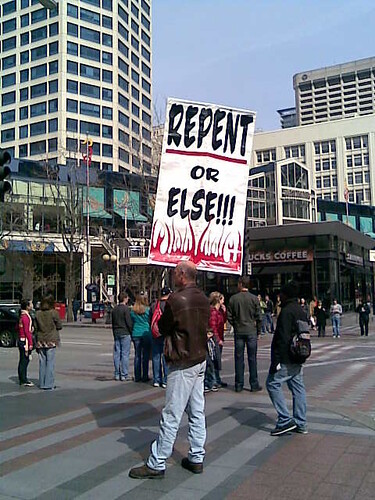
REPENT, OR ELSE!


Then God saw their works, that they turned from their evil way; and God relented from the disaster that He had said He would bring upon them, and He did not do it.  (Jonah 3:10)
Christ’s final words to the church are not the Great Commission in Matthew 28, but the messages to the seven churches in Revelation 2-3.  That message could be summed up as, “Repent, or else!”  It is a steady drumbeat throughout the Bible—from Old Testament prophets, to the New Testament herald John the Baptist, and it was the message of Jesus and His Apostles.  It is the Word God has given today and every day—we must turn from our sin and come to God—or there will be dire consequences.  The second chapter of Jonah features a repentant prophet, and the third chapter presents a repentant people. 
When we come to chapter three, the repentance of Jonah is evident (v.1-4).  He turned from disobedience to devotion.  God gave his rebellious servant a second chance.  Aren’t you thankful that God is the God of second chances—and more?  The Biblical term for this is “longsuffering.”  Repentance would bring restoration of Jonah’s usefulness.  Recall how far Peter fell in denying Christ, but how the broken man, so contrite, was reclaimed by grace.  It can happen to you.  If the Devil has taken you on a detour, how can you get back where you need to be?  You get back on the right road where you got off (v.2).  Jonah wasn’t given a new commission, but a recommission.  A return to obedience is repentance.
Then came the repentance of the people (v.5-9).  They turned from sin to salvation.  The preacher surely got their attention—a lone Jew in a Gentile land, his skin maybe bleached white from the whale’s gastric juices, seaweed draped around him, and smelling of rotting fish!  Quite a sight and quite a smell—quite a sermon also!  It was a simple message, “Yet forty days, and Nineveh shall be overthrown!”  That was a pithy proclamation, pointed and powerful.  There is power in the Word of God!  When the people heard and heeded the call to repentance an entire society was transformed.  It began with one man’s faithful proclamation.  If I didn’t believe in that possibility, I wouldn’t be up this early, sharing this message.  Notice the impact the Word had on the government.  Would to God there would be a national day of repentance—of fasting and mourning over sin, which would be declared and demonstrated in Washington, D.C.!  God may have said today, “Yet forty days, and America shall be overthrown!”
If we repent, then God relents (v.10).  God turned from destruction to delay.  Nineveh was given a reprieve.  Later on, the Assyrians returned to their wicked ways, and God brought the judgment He had promised (read Nahum), but at this moment, God hits the pause button from the impending judgment.  The unchanging God who judges wickedness is also unchanging in His willingness to forgive—if we change. 
The conditions whereby God promised imminent wrath were no longer present, but rather the contrite hearts that God promises to receive were now found in Nineveh.  his is the greatest miracle in Jonah’s story.  People are incredulous that he survived being swallowed by a whale, yet that is nothing compared to the transformation of a town through such a simple sermon!  Peter tells us that God is holding back His judgment to give us an opportunity to repent (2 Pet.3:9).  Will we seize the opportunity?  Repent, or else!